Loading...

Recent Posts

Wednesday, May 11, 2011

The cause of evil thoughts

Excerpt From: Orthodox psychotherapy

CHAPTER III


What we have written about the nature of evil thoughts also shows their causes. According to St. Gregory of Sinai, the origin and cause of evil thoughts lies in "the splitting up, through man's transgression, of his single and simple memory" (398). Before his transgression man's memory was simple, that is, it had no passion and it was turned entirely towards God. All the powers of the soul were centred on God. Immediately after the transgression this single memory was split up. St. Thalassios teaches that evil thoughts arise from three sources: the senses, the memory, and the body's temperament. The worst are those that come from the memory (399).

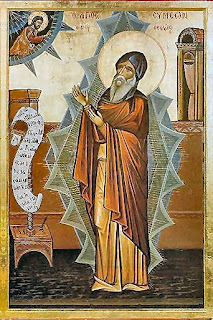
Selected quotes from St. Symeon the New Theologian

"The flame of a fire always reaches upwards, even if you turn the lighted stick upside down. And in the same way the heart of the proud man is incapable of humility. The more you give him suitable advice, the more he elevates himself. If you admonish or rebuke him he answers back aggressively, but if you praise or encourage him he is shamefully puffed up."

Apostles Jason and Sosipater of the Seventy, and their companions

    The Disciple Jason hailed from Tarsus (Asia Minor). He was the first Christian in the city.  The Disciple Sosipater was a native of Achaeia. They both became disciples of the Apostle Paul, who even called them his "kinsmen" (Rom. 16: 21). Saint Jason was made bishop in his native city of Tarsus, and Saint Sosipater -- in Iconium. They set out to the West preaching the Gospel, and in the year 63 they reached the island of Kerkyra (Korfu) in the Ionian Sea near Greece.

Daily Reading

Wednesday

LITURGY

Acts 8:18-25

     18 And when Simon saw that through laying on of the apostles' hands the Holy Ghost was given, he offered them money, 19 Saying, Give me also this power, that on whomsoever I lay hands, he may receive the Holy Ghost. 20 But Peter said unto him, Thy money perish with thee, because thou hast thought that the gift of God may be purchased with money. 21 Thou hast neither part nor lot in this matter: for thy heart is not right in the sight of God. 22 Repent therefore of this thy wickedness, and pray God, if perhaps the thought of thine heart may be forgiven thee. 23 For I perceive that thou art in the gall of bitterness, and in the bond of iniquity. 24 Then answered Simon, and said, Pray ye to the LORD for me, that none of these things which ye have spoken come upon me. 25 And they, when they had testified and preached the word of the Lord, returned to Jerusalem, and preached the gospel in many villages of the Samaritans.

Tuesday, May 10, 2011

Selected quotes from St. John Climacus

"The beginning of prayer is the expulsion of distractions from the very start by a single thought, the middle stage is the concentration on what is being said or thought; its conclusion is rapture in the Lord."

Hieromartyr Symeon the Kinsman of the Lord

    The Holy Disciple and PriestMartyr Simeon, Kinsman of the Lord, was the son of Cleopas, younger brother of Saint Joseph the Betrothed. In his adolescent years he beheld the miracles of the Lord Jesus Christ, believed in Him and became one of the 70 Disciples. Saint Simeon preached the teachings of Christ, exhorted the truths of holy faith and denounced idol-worship. After the killing of the holy Apostle James, the first bishop of Jerusalem (+ 63, Comm. 23 October) -- in his place the Christians chose the holy Disciple Simeon. During the reign of emperor Trajan (98-117) it was reported to the Roman governor Atticus that Saint Simeon was descended from the lineage of King David (the Romans exterminated all the descendants of King David) and was confessing the Christian faith. The pagans seized hold of Saint Simeon, who at that time was already an hundred year old man, and after lengthy torture they crucified him on a cross.


© 1997 by translator Fr. S. Janos

Daily Reading

Tuesday

LITURGY

Acts 8:5-17

     5 Then Philip went down to the city of Samaria, and preached Christ unto them. 6 And the people with one accord gave heed unto those things which Philip spake, hearing and seeing the miracles which he did. 7 For unclean spirits, crying with loud voice, came out of many that were possessed with them: and many taken with palsies, and that were lame, were healed. 8 And there was great joy in that city. 9 But there was a certain man, called Simon, which beforetime in the same city used sorcery, and bewitched the people of Samaria, giving out that himself was some great one: 10 To whom they all gave heed, from the least to the greatest, saying, This man is the great power of God. 11 And to him they had regard, because that of long time he had bewitched them with sorceries. 12 But when they believed Philip preaching the things concerning the kingdom of God, and the name of Jesus Christ, they were baptized, both men and women. 13 Then Simon himself believed also: and when he was baptized, he continued with Philip, and wondered, beholding the miracles and signs which were done. 14 Now when the apostles which were at Jerusalem heard that Samaria had received the word of God, they sent unto them Peter and John: 15 Who, when they were come down, prayed for them, that they might receive the Holy Ghost: 16 (For as yet he was fallen upon none of them: only they were baptized in the name of the Lord Jesus.) 17 Then laid they their hands on them, and they received the Holy Ghost.

Monday, May 09, 2011

Daily Reading

Monday

LITURGY

Acts 6:8-7:5, 47-60

     8 And Stephen, full of faith and power, did great wonders and miracles among the people. 9 Then there arose certain of the synagogue, which is called the synagogue of the Libertines, and Cyrenians, and Alexandrians, and of them of Cilicia and of Asia, disputing with Stephen. 10 And they were not able to resist the wisdom and the spirit by which he spake. 11 Then they suborned men, which said, We have heard him speak blasphemous words against Moses, and against God. 12 And they stirred up the people, and the elders, and the scribes, and came upon him, and caught him, and brought him to the council, 13 And set up false witnesses, which said, This man ceaseth not to speak blasphemous words against this holy place, and the law: 14 For we have heard him say, that this Jesus of Nazareth shall destroy this place, and shall change the customs which Moses delivered us. 15 And all that sat in the council, looking stedfastly on him, saw his face as it had been the face of an angel. 1 Then said the high priest, Are these things so? 2 And he said, Men, brethren, and fathers, hearken; The God of glory appeared unto our father Abraham, when he was in Mesopotamia, before he dwelt in Charran, 3 And said unto him, Get thee out of thy country, and

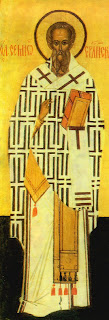
Hieromartyr Basil, Bishop of Amasea

The PriestMartyr Basil, Bishop of Amasea, lived at the beginning of the IV Century in the Pontine city of Amasea. He encouraged and comforted the Christians, suffering persecution by the pagans. During this time the Eastern part of the Roman empire was ruled by Licinius (312-324), a relative by marriage to the holy Equal-to-the-Apostles emperor Constantine the Great (306-337, Comm. 21 May). Licinius deceitfully undersigned Constantine's "Edict of Religious Toleration" (313), which permitted the freely open confession of Christianity, but at heart he hated Christians and continued to persecute them to return to paganism.