Loading...

Recent Posts

Friday, March 12, 2010

Sayings of the Holy Fathers:

Various selected quotes from St. Peter of Damaskos:

"There are four forms of wisdom: first moral judgment, or the knowledge of what should and should not be done, combined with watchfulness of the intellect; second, self-restraint, whereby our moral purpose is safeguarded and kept free from all acts, thoughts and words that do not accord with God; third, courage, or strength and endurance in sufferings, trials and temptations encountered on the spiritual path; and fourth, justice, which consists in maintaining a proper balance between the first three. These four general virtues arise from the three powers of the soul in the following manner: from the intelligence, or intellect, come moral judgment and justice, or discrimination; from the desiring power comes self-restraint; and from the incensive power comes courage."

+ + + 

"...through patient endurance we may be granted forgiveness for many sins. Moreover, if we do not forgive others their debts, the Father will not forgive us our debts (cf. Matt. 6:15). Indeed, nothing leads more swiftly to the forgiveness of sins than this virtue or commandment: 'Forgive, and you will be forgiven' (cf. Matt. 6:14)."

 + + +

"...gentleness is the substance of humility, and humility is the door leading to dispassion. Through dispassion a man enters into perfect unfaltering love; for he understands his own nature - what it was before birth and what it will be after death."

Daily Reading

Friday

SIXTH HOUR

Isaiah 29:13-23

     13 Wherefore the Lord said, Forasmuch as this people draw near me with their mouth, and with their lips do honour me, but have removed their heart far from me, and their fear toward me is taught by the precept of men: 14 Therefore, behold, I will proceed to do a marvellous work among this people, even a marvellous work and a wonder: for the wisdom of their wise men shall perish, and the understanding of their prudent men shall be hid. 15 Woe unto them that seek deep to hide their counsel from the LORD, and their works are in the dark, and they say, Who seeth us? and who knoweth us? 16 Surely your turning of things upside down shall be esteemed as the potter's clay: for shall the work say of him that made it, He made me not? or shall the thing framed say of him that framed it, He had no understanding? 17 Is it not yet a very little while, and Lebanon shall be turned into a fruitful field, and the fruitful field shall be esteemed as a forest? 18 And in that day shall the deaf hear the words of the book, and the eyes of the blind shall see out of obscurity, and out of darkness. 19 The meek also shall increase their joy in the LORD, and the poor among men shall rejoice in the Holy One of Israel. 20 For the terrible one is brought to nought, and the scorner is consumed, and all that watch for iniquity are cut off: 21 That make a man an offender for a word, and lay a snare for him that reproveth in the gate, and turn aside the just for a thing of nought. 22 Therefore thus saith the LORD, who redeemed Abraham, concerning the house of Jacob, Jacob shall not now be ashamed, neither shall his face now wax pale. 23 But when he seeth his children, the work of mine hands, in the midst of him, they shall sanctify my name, and sanctify the Holy One of Jacob, and shall fear the God of Israel.


VESPERS

Genesis 12:1-7

     1 Now the LORD had said unto Abram, Get thee out of thy country, and from thy kindred, and from thy father's house, unto a land that I will shew thee: 2 And I will make of thee a great nation, and I will bless thee, and make thy name great; and thou shalt be a blessing: 3 And I will bless them that bless thee, and curse him that curseth thee: and in thee shall all families of the earth be blessed. 4 So Abram departed, as the LORD had spoken unto him; and Lot went with him: and Abram was seventy and five years old when he departed out of Haran. 5 And Abram took Sarai his wife, and Lot his brother's son, and all their substance that they had gathered, and the souls that they had gotten in Haran; and they went forth to go into the land of Canaan; and into the land of Canaan they came. 6 And Abram passed through the land unto the place of Sichem, unto the plain of Moreh. And the Canaanite was then in the land. 7 And the LORD appeared unto Abram, and said, Unto thy seed will I give this land: and there builded he an altar unto the LORD, who appeared unto him.

Proverbs 14:15-26

     15 The simple believeth every word: but the prudent man looketh well to his going. 16 A wise man feareth, and departeth from evil: but the fool rageth, and is confident. 17 He that is soon angry dealeth foolishly: and a man of wicked devices is hated. 18 The simple inherit folly: but the prudent are crowned with knowledge. 19 The evil bow before the good; and the wicked at the gates of the righteous. 20 The poor is hated even of his own neighbour: but the rich hath many friends. 21 He that despiseth his neighbour sinneth: but he that hath mercy on the poor, happy is he. 22 Do they not err that devise evil? but mercy and truth shall be to them that devise good. 23 In all labour there is profit: but the talk of the lips tendeth only to penury. 24 The crown of the wise is their riches: but the foolishness of fools is folly. 25 A true witness delivereth souls: but a deceitful witness speaketh lies. 26 In the fear of the LORD is strong confidence: and his children shall have a place of refuge.


LITURGY OF THE PRESANCTIFIED GIFTS

+ + + 


ST PROCOPIOS THE CONFESSOR OF DECAPOLIS

Troparion    Tone 1
Thou didst advance in asceticism, O Father Procopios,/ and go from strength to strength./ By worshipping the icon of Christ thou didst share the lot of the Martyrs;/ with them ever intercede for those who cry to thee:/ Glory to Him Who has strengthened thee; glory to Him Who has crowned thee;/ glory to Him Who through thee works healings for all.

Kontakion    Tone 4
Today the Church obtains in thee a morning star,/ and by honouring thee dispels the darkness of heresy,/ O glorious Procopios, initiate of heaven.

Thursday, March 11, 2010

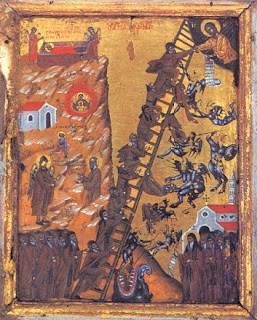
A Homily on St. John Climacus and the Ladder of Divine Ascent

Hat tip:B.C.


By Blessed Metroplitan Philaret (of blessed memory)

In the name of the Father, and of the Son, and of the Holy Spirit.

More than once, brethren, the fact has been mentioned that on each Sunday in the Great Fast (i.e., Lent) there are other commemorations besides that of the Resurrection. Thus, on this day, the Church glorifies the righteous John of the Ladder, one of the greatest ascetics, which the Church, in speaking of them, calls "earthly angels and Heavenly men."

These great ascetics were extraordinary people. They commanded the elements; wild beasts willingly and readily obeyed them. For them, there were no maladies they could not cure. They walked on the waters as on dry land; all the elements of the world were subject to them, because they lived in God and had the power of grace to overcome the laws of terrestrial nature. One such ascetic was St. John of the Ladder.

He was surnamed "of the Ladder" (Climacus) because he wrote an immortal work, the "Ladder of Divine Ascent." In this work, we see how, by means of thirty steps, the Christian gradually ascends from below to the heights of supreme spiritual perfection. We see how one virtue leads to another, as a man rises higher and higher and finally attains to that height where there abides the crown of the virtues, which is called "Christian love."

Saint John wrote his immortal work especially for the monastics, but in the past his "Ladder" was always favorite reading in Russia for anyone zealous to live piously, though he were not a monk. Therein the Saint clearly demonstrates how a man passes from one step to the next.

Remember, Christian soul, that this ascent on high is indispensable for anyone who wishes to save his soul unto eternity.

When we throw a stone up, it ascends until the moment when the propelling force ceases to be effectual. So long as this force acts, the stone travels higher and higher in its ascent, overcoming the force of the earth’s gravity. But when this force is spent and ceases to act, then, as you know, the stone does not remain suspended in the air. Immediately, it begins to fall, and the further it falls the greater the speed of its fall. This, solely according to the physical laws of terrestrial gravity.

So it is also in the spiritual life. As a Christian gradually ascends, the force of spiritual and ascetical labours lifts him on high. Our Lord Jesus Christ said: "Strive to enter in through the narrow gate." That is, the Christian ought to be an ascetic. Not only the monastic, but every Christian. He must take pains for his soul and his life. He must direct his life on the Christian path, and purge his soul of all filth and impurity.
Now, if the Christian, who is ascending upon this ladder of spiritual perfection by his struggles and ascetic labours, ceases from this work and ascetic toil, his soul will not remain in its former condition; but, like the stone, it will fall to the earth. More and more quickly will it drop until, finally, if the man does not come to his senses, it will cast him down into the very abyss of Hell.

It is necessary to remember this. People forget that the path of Christianity is indeed an ascetical labour. Last Sunday, we heard how the Lord said: "He that would come after Me, let him take up his cross, deny himself, and follow Me." The Lord said this with the greatest emphasis. Therefore, the Christian must be one who takes up his cross, and his life, likewise, must be an ascetic labour of bearing that cross. Whatever the outward circumstance of his life, be he monk or layman, it is of no consequence. In either case, if he does not force himself to mount upwards, then, of a certainty, he will fall lower and lower.

And in this regard, alas, people have confused thoughts. For example, a clergyman drops by a home during a fast. Cordially and thoughtfully, they offer him fast food (i.e., food prepared according to the rules of the Fast), and say: "For you, fast food, of course!" To this, one of our hierarchs customarily replies: "Yes, I am Orthodox. But who gave you permission not to keep the fasts?" All the fasts of the Church, all the ordinances, are mandatory for every Orthodox person. Speaking of monastics, such ascetics as St. John of the Ladder and those like him fasted much more rigorously than the Church prescribes; but this was a matter of their spiritual ardour, an instance of their personal ascetic labour. This the Church does not require of everyone, because it is not in accord with everyone’s strength. But the Church DOES require of every Orthodox the keeping of those fasts which She has established.

Oftentimes have I quoted the words of Saint Seraphim, and once again shall I mention them. Once there came to him a mother who was concerned about how she might arrange the best possible marriage for her young daughter. When she came to Saint Seraphim for advice, he said to her: "Before all else, ensure that he, whom your daughter chooses as her companion for life, keeps the fasts. If he does not, then he is not a Christian, whatever he may consider himself to be." You see how the greatest saint of the Russian Church, Saint Seraphim of Sarov, a man who, better than we, knew what Orthodoxy is, spoke concerning the fasts?

Let us remember this. Saint John Climacus has described the ladder of spiritual ascent: then let us not forget that each Christian must ascend thereon. The great ascetics ascended like swiftly-flying eagles; we scarcely ascend at all. Nonetheless, let us not forget that, unless we employ our efforts in correcting ourselves and our lives, we shall cease our ascent, and, most assuredly, we shall begin to fall. Amen.
>From St. John Climacus, "The Ladder of Divine Ascent," (Boston: Holy Transfiguration Monastery, 1978), pp. xxxi - xxxiii.

Wednesday, March 10, 2010

On Humility:

This seems a strange thing, for humility alone is opposite to vainglory, and it is from this, I suppose, that it guards a man. But a man grows angry over riches and what he has to eat; why then does he say that humility does not get angry, or provoke to anger? Humility is a great thing (as we keep on saying) and it is powerful to bring down grace to the soul. For the rest, the grace of God itself, coming into the soul, protects it from these other two grievous passions, for what is more grievous to a man than to grow angry and to anger his neighbor? As one of the Seniors says, "it is completely foreign to a monk to grow angry, unless he is swiftly protected by humiliating himself, in a short time, troubled as he is, and troubling others, he comes under the power of the devil.

For this reason he says that humility does not get angry or provoke to anger; but why am I saying that it protects from these two passions? In point of fact humility protects the soul from all passions and also from every temptation. When Blessed Anthony saw all the snares of the devil spread out everywhere, he sighed, and asked God how anyone could ever avoid them. God answered him, 'Humility. It is humility that enables you to escape them all!" And what is more astonishing, he added, "They cannot even touch you".

Dorotheos of Gaza: Discourses and Sayings, On Humility

On remembrance of sins

The forgetting of wrongs is a sign of true repentance. But he who dwells on them and thinks that he is repenting is like a man who thinks he is running while he is really asleep.

St. John Climacus

Tuesday, March 09, 2010

THE FIRST (IV) AND THE SECOND DISCOVERY OF THE HEAD OF JOHN THE FORERUNNER.

After the cutting off of the Head of the Prophet, ForeRunner and Baptist John (Comm. 29 August), his body was buried by disciples in the Samarian city of Sebasteia, and the venerable head was hidden by Herodias in an unclean place. Pious Joanna, wife of king Herod's steward Chuza (there is made mention about him by the holy evangelist Luke -- Lk 8: 3), secretly took the holy head and placed it into a vessel and buried it on the Mount of Olives -- in one of the properties of Herod.

After many years this property passed into the possession of the dignitary Innocentius, who began to build a church there. When they dug a trench for the foundation, the vessel with the venerable head of John the Baptist was uncovered. Innocentius recognised the great holiness of it from the signs of grace occurring from it. Thus occurred the First Discovery of the Head. Innocentius preserved it with great piety, but before his own death, fearful so that the holy relic should not be abused by unbelievers, he again hid it in that same place, where it was found...Upon his death the church fell into ruin and was destroyed.

During the days of Equal-to-the-Apostles Constantine the Great (+ 337, Comm. 21 May), when the Christian faith began to flourish, the holy ForeRunner himself appeared twice unto two monks journeying to Jerusalem on pilgrimage to the holy places, and he revealed the location of his venerable head. The monks uncovered the holy relic and, placing it into a sack of camel-hair, they proceeded homewards. Along the way they encountered an un-named potter and gave him to carry the precious burden. Not knowing what he was carrying, the potter continued on his way. But the holy ForeRunner himself appeared to him and ordered him to flee from the careless and lazy monks, together with that which was in his hands. The potter concealed himself from the monks and at home he preserved the venerable head with reverence. Before his death he sealed it into a water-carrying vessel and gave it over to his sister. From that time the venerable head was successively preserved by pious christians, until the priest Eustathios infected with the Arian heresy -- came into possession of it. He seduced a multitude of the infirm, healed by the holy head, adding abundance to the heresy. When his blasphemy was uncovered, he was compelled to flee. Having buried the holy relic in a cave, near Emessus, the heretic intended to afterwards return and again take possession of it for disseminating falsehood. But God did not permit this. Pious monks settled into the cave, and then at this place arose a monastery. In the year 452 Saint John the Baptist in a vision to the archimandrite of this monastery Marcellus indicated the place of concealment of his head. This became celebrated as the Second Discovery. The holy relic was transferred to Emessus, and later to Constantinople.

Copyright 1997 by translator Fr. S. Janos.

Patient Endurance

If those attacked by many passions of soul and body endure patiently, do not out of negligence surrender their free will, and do not despair, they are saved. Similarly, he who has attained the state of dispassion, freedom from fear and lightness of heart, quickly falls if he does not confess God's grace continually by not judging anyone. Indeed, should he dare to judge someone, he makes it evident that in acquiring his wealth he has relied on his own strength, as St. Maximus states.

St. Peter of Damaskos

St. John Chrysostom on Fasting:

I speak not, indeed, of such a fast as most persons keep, but of real fasting; not merely an abstinence from meats; but from sins too. For the nature of a fast is such, that it does not suffice to deliver those who practice it, unless it be done according to a suitable law. "For the wrestler," it is said, "is not crowned unless he strive lawfully." To the end then, that when we have gone through the labour of fasting, we forfeit not the crown of fasting, we should understand how, and after what manner, it is necessary to conduct this business; since that Pharisee also fasted, but afterwards went down empty, and destitute of the fruit of fasting. The Publican fasted not; and yet he was accepted in preference to him who had fasted; in order that thou mayest learn that fasting is unprofitable, except all other duties follow with it. The Ninevites fasted, and won the favour of God. The Jews, fasted too, and profited nothing, nay, they departed with blame. Since then the danger in fasting is so great to those who do not know how they ought to fast, we should learn the laws of this exercise, in order that we may not "run uncertainly," nor "beat the air," nor while we are fighting contend with a shadow. Fasting is a medicine; but a medicine, though it be never so profitable, becomes frequently useless owing to the unskilfulness of him who employs it. For it is necessary to know, moreover, the time when it should be applied, and the requisite quantity of it; and the temperament of body that admits it; and the nature of the country, and the season of the year; and the corresponding diet; as well as various other particulars; any of which, if one overlooks, he will mar all the rest that have been named. Now if, when the body needs healing, such exactness is required on our part, much more ought we, when our care is about the soul, and we seek to heal the distempers of the mind, to look, and to search into every particular with the utmost accuracy.

HOMILIES OF ST. JOHN CHRYSOSTOM, ADDRESSED TO THE PEOPLE OF ANTIOCH, CONCERNING THE STATUES (HOMILY III,v.8)

Daily Reading:

Tuesday

SIXTH HOUR

Isaiah 25:1-9

     1 O Lord, thou art my God; I will exalt thee, I will praise thy name; for thou hast done wonderful things; thy counsels of old are faithfulness and truth. 2 For thou hast made of a city an heap; of a defenced city a ruin: a palace of strangers to be no city; it shall never be built. 3 Therefore shall the strong people glorify thee, the city of the terrible nations shall fear thee. 4 For thou hast been a strength to the poor, a strength to the needy in his distress, a refuge from the storm, a shadow from the heat, when the blast of the terrible ones is as a storm against the wall. 5 Thou shalt bring down the noise of strangers, as the heat in a dry place; even the heat with the shadow of a cloud: the branch of the terrible ones shall be brought low. 6 And in this mountain shall the LORD of hosts make unto all people a feast of fat things, a feast of wines on the lees, of fat things full of marrow, of wines on the lees well refined. 7 And he will destroy in this mountain the face of the covering cast over all people, and the vail that is spread over all nations. 8 He will swallow up death in victory; and the Lord GOD will wipe away tears from off all faces; and the rebuke of his people shall he take away from off all the earth: for the LORD hath spoken it. 9 And it shall be said in that day, Lo, this is our God; we have waited for him, and he will save us: this is the LORD; we have waited for him, we will be glad and rejoice in his salvation.


VESPERS

Genesis 9:8-17

     8 And God spake unto Noah, and to his sons with him, saying, 9 And I, behold, I establish my covenant with you, and with your seed after you; 10 And with every living creature that is with you, of the fowl, of the cattle, and of every beast of the earth with you; from all that go out of the ark, to every beast of the earth. 11 And I will establish my covenant with you, neither shall all flesh be cut off any more by the waters of a flood; neither shall there any more be a flood to destroy the earth. 12 And God said, This is the token of the covenant which I make between me and you and every living creature that is with you, for perpetual generations: 13 I do set my bow in the cloud, and it shall be for a token of a covenant between me and the earth. 14 And it shall come to pass, when I bring a cloud over the earth, that the bow shall be seen in the cloud: 15 And I will remember my covenant, which is between me and you and every living creature of all flesh; and the waters shall no more become a flood to destroy all flesh. 16 And the bow shall be in the cloud; and I will look upon it, that I may remember the everlasting covenant between God and every living creature of all flesh that is upon the earth. 17 And God said unto Noah, This is the token of the covenant, which I have established between me and all flesh that is upon the earth.

Proverbs 12:8-22

     8 A man shall be commended according to his wisdom: but he that is of a perverse heart shall be despised. 9 He that is despised, and hath a servant, is better than he that honoureth himself, and lacketh bread. 10 A righteous man regardeth the life of his beast: but the tender mercies of the wicked are cruel. 11 He that tilleth his land shall be satisfied with bread: but he that followeth vain persons is void of understanding. 12 The wicked desireth the net of evil men: but the root of the righteous yieldeth fruit. 13 The wicked is snared by the transgression of his lips: but the just shall come out of trouble. 14 A man shall be satisfied with good by the fruit of his mouth: and the recompence of a man's hands shall be rendered unto him. 15 The way of a fool is right in his own eyes: but he that hearkeneth unto counsel is wise. 16 A fool's wrath is presently known: but a prudent man covereth shame. 17 He that speaketh truth sheweth forth righteousness: but a false witness deceit. 18 There is that speaketh like the piercings of a sword: but the tongue of the wise is health. 19 The lip of truth shall be established for ever: but a lying tongue is but for a moment. 20 Deceit is in the heart of them that imagine evil: but to the counsellors of peace is joy. 21 There shall no evil happen to the just: but the wicked shall be filled with mischief. 22 Lying lips are abomination to the LORD: but they that deal truly are his delight.


LITURGY OF THE PRESANCTIFIED GIFTS

+ + + 

FIRST AND SECOND FINDING OF THE VENERABLE HEAD OF THE FORERUNNER AND BAPTIST JOHN
ST CUMINE, ABBOT


Troparion of the Forerunner    Tone 4
The head of the Forerunner has risen from the earth/ and sends forth healing rays of incorruption to all the faithful./ In heaven it is mustering a host of Angels,/ and on earth it is assembling mankind/ to ascribe glory to our God.

Troparion of St Cumine    Tone 8
Thou didst record for us the Life of our Father Colum Cille, O holy Father Cumine,/ showing forth in this wise the Orthodox understanding of hagiology./ Commemorating thee, we pray for thy speedy help and direction,/ that by following thee we may be led into the way of salvation.

Kontakion of the Forerunner    Tone 2
O Prophet of God and Forerunner of Grace,/ having obtained thy head from the earth as a most sacred rose,/ we are always receiving healings;/ for still as of old in the world/ thou preachest repentance.

Kontakion of St Cumine    Tone 5
Praise and honour are thy due, O Father Cumine,/ for thou dost reveal to us the reality of the Communion of Saints/ and thereby dost demonstrate our need for a spiritual father./ Wherefore raising our voices in intercession,/ we entreat thee to pray to God for us,/ that we may amend our lives/ and follow in the footsteps of our righteous forefathers.

Monday, March 08, 2010

PRAYER, FEASTS, AND FASTS

By Metropolitan Philaret of New York of Holy Memory


We all understand how important prayer is for the spiritual life of an Orthodox Christian. But how are we to pray? Two forms of prayer are evident in the Orthodox Christian life: private prayers said at home and unified Church prayer. Each has certain special characteristics. Our Saviour gave instructions in the Gospel about private prayer: "When you pray, go into your room and shut the door, pray to your Father Who is in secret; and your Father Who sees in secret will reward you openly" (St. Matthew 6:6). Of course, home prayers are basic to us. Prayer is deeply intimate and heartfelt. Everyone who has sincerely searched for heartfelt and moving prayer, knows well how easy and natural it is to pray in solitude, in silence and peace. Moreover, our Lord firmly warns us against hypocritical prayer done for show, to elicit praise from people.

When a Christian prays to God, he must strive to contemplate the words of the prayers which he reads, and to concentrate his thought on the content of the prayers. Everyone knows how difficult it is to struggle against the pressure of outside thoughts and images which tiresomely besiege the person who is praying. This comes to us both from our personal distraction and from the indirect action of the evil-one. The task of a Christian is to apply all his powers to persistently shake off all these side thoughts (which are sometimes impure) that torment him, and to pray piously and with concentration. One should remember that an extra pressure of thoughts and images—often vile and blasphemous—comes to us directly from Satan, and the struggle of resisting these thoughts is a direct struggle against evil. Consequently, one receives great benefit from such a struggle.

Usually, we pray with Church prayers which we learn from childhood. This is necessary, because they lead us into that prayerful atmosphere by which the Church breathes. In this, one must beware not to slide into an automatic, mechanical reading of prayers without attention and penetration into the sense and meaning of the words of the prayer. To this end, a full reverence and concentration of attention is demanded, so that one actually prays—converses with God.

According to the harmonious testimonies of the great ascetics of prayer, in addition to reading the Church prayers, one must add their own prayers in their own words, praying for one's own spiritual needs, and for neighbours and enemies. Often, a Christian cannot fully express his feelings and afflictions in the words of the written prayers. In this case, a living, sincere prayer in one's own words is more appropriate, together with a confession of one's daily sins and an expressed determination to struggle, with God's help, against those daily sins. Such a prayer will come from the depth of the human soul.

Only a person who has developed sincere, penetrating and constant home prayer can fully participate in the public prayers in church. This participation is a firm necessity for every Christian. The Lord Himself said, "Where two or three [members of the Church] are gathered together in My name, there am I in the midst of them." The great preacher and teacher of prayer St John Chrysostom says, "One can, of course, pray at home also: but you cannot pray there as you do in church where so many people are gathered, where a harmonious voice is raised to God: for here is something greater than individual prayer: one-mindedness, a union of love, the prayers of the priest. During public prayers, not only do the people send up their own voices to God, but together with them, the angels and archangels glorify the Master." Thus, church prayer has a preeminently sacred character and it is given this nature by the grace of the Holy Spirit which, as we know, enlivens our spiritual life, cooperating with our personal spiritual efforts.

A priest serves in church; he is not a priest because he receives a theological education, or has a calling to serve the Church. All this only prepares him for pastoral service. He is a priest only because he was consecrated to it by ordination, and enters through the mystery of priesthood into the pastorship, of the Church. So it is that our church is a consecrated temple, with a specially consecrated Holy Table. According to the word of the Holy Scripture, our church is a house of prayer. The Lord gave us an example of the honour due to God's house when, during His earthly sojourn, He twice cleansed it of all disorder and indecency. At the divine services, we repeatedly hear the Holy Church exclaim the petition, "For this holy house and for all those who with faith, reverence and fear of God enter herein, let us pray to the Lord." Each of us must enter a church in this disposition, remembering that here, one stands before the face of the Lord Himself.

One of the greatest and most painfully evident deficiencies of our contemporary life is our inability to celebrate our feasts in a Christian manner. Our lives are ordered in such a way that interests of a purely worldly character dominate them. Jobs, worry over income and shallow considerations and impressions of each day—all this fills our time and man does not have time to simply think about his soul, and its demands and needs. Our feasts are windows in our colourless lives of vanity and worldly cares. They teach us that this world is not so empty and impoverished as it seems to us, for above it, there is a different world giving our souls joy and ineffable peace. Who does not know what joy fills the heart of an Orthodox Christian in the days of the greatest feast, Pascha, the Radiant Resurrection of the Lord?

How often, though, do days of Christian commemoration and festivity turn out to be days of even greater emptiness and senseless idleness. A feast is a special day of God and should be dedicated as fully as possible to prayer and deeds of Christian mercy. In our tunes though, the feasts are often treated as any other day, and sometimes people even use them as excuses for drunkenness and unseemly partying. How often do we see that people, or even whole clubs, "societies", "institutes" and, God forbid, even parishes and diocesan centers, organize their "balls", dances and entertainments on the eves of major feasts and on the feast days themselves. How do such persons differ from pagans and atheists?

Yet more reprehensible is the way many people view the fasts which the Holy Church has given us. We have many fasts: four lengthy ones, the Great Fast (Great Lent), the Apostles' Fast, the Dormition Fast and the Nativity Fast; and a number of shorter ones.

What an amazing and un-Christian relationship so many people now have to these fasts. The fasts are violated by people without a qualm of conscience, as if the matter was about some nonsense which had no significance. The Church, on the other hand, takes a very serious view of the matter, and excludes from Holy Communion those who refuse to keep the fasts without cause. Indeed, St Seraphim of Sarov very pointedly said, "One who does not observe the fasts is not a Christian, no matter what he considers or calls himself ... and you should not pay attention to him, no matter what he says."

Fasting is absolutely indispensable for man. From the external aspect, it is a struggle of filial obedience to God, Who has given us the rules of fasting through His Holy Spirit. From the inner aspect, fasting is a struggle of restraint and self-limitation. In this lies the great value and sense of fasting, since a strict observance of fasts tempers one's will and perfects the character of one who is firm in his religious convictions and actions. Let us not forget that Christ Himself fasted, and foretold that His apostles would also fast.

We hear people claiming that fasting is harmful to the health. But strict fasting is not required of people who are ill, and they fast only according to their strength. Most important, one should remember that it is only those people who do not fast who speak about the "harm to health" of fasting. But those who do observe fasting will never say this, for they know from personal experience that not only is fasting not harmful, but it is positively beneficial to bodily health.

Fasting is not merely a restraining from food. During the days of the fasts, the Church sings, "While fasting bodily, let us also fast spiritually..." True fasting includes deeds of Christian mercy. It is an alienation of the evil-one, a restraint of the tongue, a laying aside of anger, a cutting off of vices and an exposure of falsehood... Thus, for a Christian, fasting is a time of restraint and self-education in all respects, and a real Christian fast gives believers a great moral satisfaction. The great teacher of Christian asceticism Bishop Theophan the Recluse says of fasting:

"Fasting appears gloomy until one steps into its arena. But begin and you will see what light it brings after darkness, what freedom from bonds, what release after a burdensome life...."

The Teaching of the Orthodox Faith, Number One: On Fasting

PRIESTMARTYR POLYCARP, BISHOP OF SMYRNA (+ 167)

   Sainted Polycarp, Bishop of Smyrna, was born about the year 80 and lived in Asia Minor in the city of Smyrna. He was left an orphan at an early age, but through the direction of an Angel, he was raised by the pious widow Kallista. After the death of his adoptive mother, Polycarp gave away his possessions and began to lead a chaste life, caring for the sick and the infirm. He was very fond of and close to the holy bishop of Smyrna Bukolos (Comm. 6 February). He ordained Polycarp as deacon, entrusting to him to preach the Word of God in church.

    At this time the holy Apostle John the Theologian was still alive. Saint Polycarp was especially close to Saint John the Theologian, whom he accompanied on his apostolic wanderings. Sainted Bukolos ordained Saint Polycarp presbyter, and shortly before his death expressed last wishes that he be made bishop upon the Smyrna cathedra. When the ordination of Saint Polycarp to bishop was accomplished, the Lord Jesus Christ appeared to him. Saint Polycarp guided his flock with apostolic zeal. He was also greatly loved among the clergy. With great warmth did Saint Ignatios the God-Bearer regard him. Setting out to Rome where execution awaited him (he was torn asunder by wild beasts), he wrote to Saint Polycarp: "Just as the winds and turbulence require the rudder -- for coming ashore, so likewise are the present times necessary, in order to reach God".

    The emperor Marcus Aurelius (161-180) came upon the Roman throne and started up a most fierce persecution against christians. The pagans demanded that the judge seek out Saint Polycarp -- "the father of all the christians" and "the seducer of all Asia". During this while Saint Polycarp, at the persistent urging of his flock, stayed at a small village not far from Smyrna. When the soldiers came for him, he went out to them and led them in to eat, and at this time he began to pray, having prepared himself for the deed of martyrdom. His suffering and death are recorded in "An Epistle of the Christians of the Church of Smyrna to the other Churches" -- one of the most ancient memorials of Christian literature. Having been brought to trial, Saint Polycarp firmly confessed his faith in Christ and was condemned to burning. The executioners wanted to tie him to a post, but he calmly told them that the bon-fire would not work, and they could merely tie him with ropes. The flames encircled the saint but did not touch him, coming all together over his head. Seeing that the fire did him no harm, the throng of pagans demanded that he be killed with a sword. When they inflicted the wound upon Saint Polycarp, there flowed from it so much blood, that it extinguished the flames. The body of the priestmartyr Polycarp was then committed to flame. The Christians of Smyrna reverently gathered up his venerable remains, honouring his memory as sacred.

    A story has been preserved about Saint Polycarp by his disciple, Sainted Ireneios of Lyons, which Eusebios cites in his "Ecclesiastical History" (V, 20): "I was still very young when I saw thee in Asia Minor at Polycarp's, -- writes Saint Ireneios to his friend Florinus, -- ...but I would still be able to point out the place where Blessed Polycarp sat and conversed, -- be able to depict his walk, his mannerisms in life, his outward appearance, his speaking to people, his companionable wandering with John, and how he himself related, together with other eye-witnesses of the Lord, -- those things that he remembered from the words of others and in turn told what he heard from them about the Lord, His teachings and miracles ... Through the mercy of God to me, I then already listened attentively to Polycarp and wrote down his words not on tablets, but in the depths of my heart ... Wherefore, I am able to witness before God, that if this blessed and apostolic elder heard something similar to thy fallacy, he would immediately stop up his ears and express his indignation with his usual phrase: 'Good God! That Thou hast permitted me to be alive at such a time!' ".

    During his life the sainted bishop wrote several Epistles to the flock and letters to various individuals. There has survived to the present his Epistle to the Philippians which, on the testimony of Blessed Jerome, was read in the churches of Asia Minor at Divine-services. It was written by the saint in response to the request of the Philippians to send them a letter of the PriestMartyr Ignatios, which had been preserved by Saint Polycarp.


Copyright 1997 by translator Fr. S. Janos.

Heresy Compared To The Hydra:

The tales of poets tell us that of old the hydra when its heads were cut off gained by its injuries, and sprang up more abundantly: so that owing to a miracle of a strange and unheard-of kind, its loss proved a kind of gain to the monster which was thus increased by death, while that extraordinary fecundity doubled everything which the knife of the executioner cut off, until the man who was eagerly seeking its destruction, toiling and sweating, and finding his efforts so often baffled by useless labours, added to the courage of battle the arts of craft, and by the application of fire, as they tell us, cut off with a fiery sword the manifold offspring of that monstrous body; and so when the inward parts were thus burnt, by cauterizing the rebellious throbbings of that ghastly fecundity, at length those prodigious births were brought to an end.

Thus also heresies in the churches bear some likeness to that hydra which the poets' imagination invented; for they too hiss against us with deadly tongues; and they too cast forth their deadly poison, and spring up again when their heads are cut off. But because the medicine should not be wanting when the disease revives, and because the remedy should be the more speedy as the sickness is the more dangerous, our Lord God is able to bring to pass that that may be a truth in the church's warfare, which Gentile fictions imagined of the death of the hydra, and that the fiery sword of the Holy Spirit may cauterize the inward parts of that most dangerous birth, in the new heresy to be put down, so that at last its monstrous fecundity may cease to answer to its dying throbs.

THE SEVEN BOOKS OF SAINT JOHN CASSIAN ON THE INCARNATION OF THE LORD -- AGAINST NESTORIUS, BOOK I, CHAPTER I.

Daily Reading

Monday
Fourth Week of Great Lent Tone 6

SIXTH HOUR

Isaiah 14:24-32

     24 The LORD of hosts hath sworn, saying, Surely as I have thought, so shall it come to pass; and as I have purposed, so shall it stand: 25 That I will break the Assyrian in my land, and upon my mountains tread him under foot: then shall his yoke depart from off them, and his burden depart from off their shoulders. 26 This is the purpose that is purposed upon the whole earth: and this is the hand that is stretched out upon all the nations. 27 For the LORD of hosts hath purposed, and who shall disannul it? and his hand is stretched out, and who shall turn it back? 28 In the year that king Ahaz died was this burden. 29 Rejoice not thou, whole Palestina, because the rod of him that smote thee is broken: for out of the serpent's root shall come forth a cockatrice, and his fruit shall be a fiery flying serpent. 30 And the firstborn of the poor shall feed, and the needy shall lie down in safety: and I will kill thy root with famine, and he shall slay thy remnant. 31 Howl, O gate; cry, O city; thou, whole Palestina, art dissolved: for there shall come from the north a smoke, and none shall be alone in his appointed times. 32 What shall one then answer the messengers of the nation? That the LORD hath founded Zion, and the poor of his people shall trust in it.


VESPERS

Genesis 8:21-9:7

     21 And the LORD smelled a sweet savour; and the LORD said in his heart, I will not again curse the ground any more for man's sake; for the imagination of man's heart is evil from his youth; neither will I again smite any more every thing living, as I have done. 22 While the earth remaineth, seedtime and harvest, and cold and heat, and summer and winter, and day and night shall not cease. 1 And God blessed Noah and his sons, and said unto them, Be fruitful, and multiply, and replenish the earth. 2 And the fear of you and the dread of you shall be upon every beast of the earth, and upon every fowl of the air, upon all that moveth upon the earth, and upon all the fishes of the sea; into your hand are they delivered. 3 Every moving thing that liveth shall be meat for you; even as the green herb have I given you all things. 4 But flesh with the life thereof, which is the blood thereof, shall ye not eat. 5 And surely your blood of your lives will I require; at the hand of every beast will I require it, and at the hand of man; at the hand of every man's brother will I require the life of man. 6 Whoso sheddeth man's blood, by man shall his blood be shed: for in the image of God made he man. 7 And you, be ye fruitful, and multiply; bring forth abundantly in the earth, and multiply therein.

Proverbs 11:19-12:6

     19 As righteousness tendeth to life: so he that pursueth evil pursueth it to his own death. 20 They that are of a froward heart are abomination to the LORD: but such as are upright in their way are his delight. 21 Though hand join in hand, the wicked shall not be unpunished: but the seed of the righteous shall be delivered. 22 As a jewel of gold in a swine's snout, so is a fair woman which is without discretion. 23 The desire of the righteous is only good: but the expectation of the wicked is wrath. 24 There is that scattereth, and yet increaseth; and there is that withholdeth more than is meet, but it tendeth to poverty. 25 The liberal soul shall be made fat: and he that watereth shall be watered also himself. 26 He that withholdeth corn, the people shall curse him: but blessing shall be upon the head of him that selleth it. 27 He that diligently seeketh good procureth favour: but he that seeketh mischief, it shall come unto him. 28 He that trusteth in his riches shall fall; but the righteous shall flourish as a branch. 29 He that troubleth his own house shall inherit the wind: and the fool shall be servant to the wise of heart. 30 The fruit of the righteous is a tree of life; and he that winneth souls is wise. 31 Behold, the righteous shall be recompensed in the earth: much more the wicked and the sinner. 1 Whoso loveth instruction loveth knowledge: but he that hateth reproof is brutish. 2 A good man obtaineth favour of the LORD: but a man of wicked devices will he condemn. 3 A man shall not be established by wickedness: but the root of the righteous shall not be moved. 4 A virtuous woman is a crown to her husband: but she that maketh ashamed is as rottenness in his bones. 5 The thoughts of the righteous are right: but the counsels of the wicked are deceit. 6 The words of the wicked are to lie in wait for blood: but the mouth of the upright shall deliver them.


NO LITURGY

+  + + 
HOLY HIEROMARTYR POLYCARP, BISHOP OF SMYRNA

Troparion    Tone 4
Thy name was verified by thy works,/ O wise Hieromartyr Polycarp./ Thou wast a fruitful olive tree in the house of the Lord,/ and dost nourish the Church with the spiritual bounty of thy words and deeds./ Thou dost intercede for our souls, O hierarch and steadfast Prize-winner.

Kontakion    Tone 1
Through thy virtues, O wise Polycarp,/ thou dost offer spiritual fruits to the Lord and prove to be God's worthy Hierarch./ We who have been enlightened by thy words/ today praise thy memory and glorify God.

Sunday, March 07, 2010

Daily Reading:

Third Sunday of Great Lent

MATINS (VI)

Luke 24:36-53

     36 And as they thus spake, Jesus himself stood in the midst of them, and saith unto them, Peace be unto you. 37 But they were terrified and affrighted, and supposed that they had seen a spirit. 38 And he said unto them, Why are ye troubled? and why do thoughts arise in your hearts? 39 Behold my hands and my feet, that it is I myself: handle me, and see; for a spirit hath not flesh and bones, as ye see me have. 40 And when he had thus spoken, he shewed them his hands and his feet. 41 And while they yet believed not for joy, and wondered, he said unto them, Have ye here any meat? 42 And they gave him a piece of a broiled fish, and of an honeycomb. 43 And he took it, and did eat before them. 44 And he said unto them, These are the words which I spake unto you, while I was yet with you, that all things must be fulfilled, which were written in the law of Moses, and in the prophets, and in the psalms, concerning me. 45 Then opened he their understanding, that they might understand the scriptures, 46 And said unto them, Thus it is written, and thus it behoved Christ to suffer, and to rise from the dead the third day: 47 And that repentance and remission of sins should be preached in his name among all nations, beginning at Jerusalem. 48 And ye are witnesses of these things. 49 And, behold, I send the promise of my Father upon you: but tarry ye in the city of Jerusalem, until ye be endued with power from on high. 50 And he led them out as far as to Bethany, and he lifted up his hands, and blessed them. 51 And it came to pass, while he blessed them, he was parted from them, and carried up into heaven. 52 And they worshipped him, and returned to Jerusalem with great joy: 53 And were continually in the temple, praising and blessing God. Amen.


LITURGY OF ST. BASIL

Hebrews 4:14-5:6

     14 Seeing then that we have a great high priest, that is passed into the heavens, Jesus the Son of God, let us hold fast our profession. 15 For we have not an high priest which cannot be touched with the feeling of our infirmities; but was in all points tempted like as we are, yet without sin. 16 Let us therefore come boldly unto the throne of grace, that we may obtain mercy, and find grace to help in time of need. 1 For every high priest taken from among men is ordained for men in things pertaining to God, that he may offer both gifts and sacrifices for sins: 2 Who can have compassion on the ignorant, and on them that are out of the way; for that he himself also is compassed with infirmity. 3 And by reason hereof he ought, as for the people, so also for himself, to offer for sins. 4 And no man taketh this honour unto himself, but he that is called of God, as was Aaron. 5 So also Christ glorified not himself to be made an high priest; but he that said unto him, Thou art my Son, to day have I begotten thee. 6 As he saith also in another place, Thou art a priest for ever after the order of Melchisedec.

Mark 8:34-9:1

     34 And when he had called the people unto him with his disciples also, he said unto them, Whosoever will come after me, let him deny himself, and take up his cross, and follow me. 35 For whosoever will save his life shall lose it; but whosoever shall lose his life for my sake and the gospel's, the same shall save it. 36 For what shall it profit a man, if he shall gain the whole world, and lose his own soul? 37 Or what shall a man give in exchange for his soul? 38 Whosoever therefore shall be ashamed of me and of my words in this adulterous and sinful generation; of him also shall the Son of man be ashamed, when he cometh in the glory of his Father with the holy angels. 1 And he said unto them, Verily I say unto you, That there be some of them that stand here, which shall not taste of death, till they have seen the kingdom of God come with power.

+ + + 
FINDING OF THE PRECIOUS RELICS OF THE HOLY MARTYRS IN EUGENIOS
ST ELWIN, MISSIONARY

Troparion of the Martyrs    Tone 1
O glorious Martyrs, you foundations of the Church,/ your venerable relics have appeared from the depths of the earth/ like spiritual roses and treasuries of graces./ They breathe forth the grace of healing/ and grant the fragrance of life/ to those who lovingly call you blessed.

Troparion of St Elwin    Tone 1
Leaving thy native Ireland, thou didst labour for Christ/ in the remoteness of Kernow,/ giving thyself up to ascetic struggles and missionary journeyings,/ O Father Elwin./ Wherefore we pray for courage and strength to emulate thy example/ for the salvation of our souls.

Kontakion of the Martyrs    Tone 4
Like bright lights you shone from the earth and dispelled ungodly darkness;/ you have illumined the faithful,/ O divine Martyrs, champions of the Trinity.

Troparion of St Elwin    Tone 6
Accompanied by the pious Breaca,/ thou didst go out to preach the Gospel of Christ to those who were in darkness,/ therefore we glorify thee, ever praying/ that our lives may also be spent in God-pleasing activities.

Sayings of Saint Maximos the Confessor:

If you totally fulfill the command to love your neighbour, you will feel no bitterness or resentment against him whatever he does. If this is not the case, then the reason why you fight against your brother is clearly because you seek after transitory things and prefer them to the commandment of love.

 
Second Century on Love no. 15, The Philokalia Vol. 2 edited by Palmer, Sherrard and Ware; Faber and Faber pg. 85
 
+ + +
 

Among the demons... evil takes the form of mindless anger, desire uncontrolled by the intellect, and impetuous imagination. But mindlessness, lack of intellectual control and impetuosity in intelligent beings are privations of intelligence, intellect and circumspection. But a privation is posterior to the possession of something. There was a time, then, when the demons possessed intelligence, intellect and devout circumspection. This being the case, not even the demons are evil by nature, but they have become evil through the misuse of their natural power.

Third Century on Love no. 5, The Philokalia Vol. 2 edited by Palmer, Sherrard and Ware; Faber and Faber pgs. 83-84
 
+ + +
 
It is not food that is evil but gluttony, not the begetting of children but unchastity, not material things but avarice, not esteem but self-esteem. This being so, it is only the misuse of things that is evil, and such misuse occurs when the intellect fails to cultivate its natural powers.

Third Century on Love no. 4, The Philokalia Vol. 2 edited by Palmer, Sherrard and Ware; Faber and Faber pg. 83